Saint Sophia cathedral.
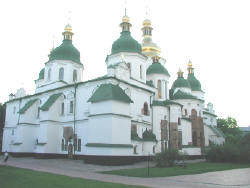 Sofiyskiy
(St. Sophia's) Monastery.
The
ensemble was built over a period of nine centuries. The complex
includes: Sofiysky (St. Sophia's) Cathedral. Constructed in 1017-31 in
honour of Prince Yaroslav the Wise's victory over the Pecheneg tribe.
Was the main metropolitan church of Kyivan Rus'-Ukraine. Ceremonies to
designate envoys, public meetings, and the writing of chronicles took
place here. The first library in Kyivan Rus was located here. The
cathedral bears a resemblance to Byzantine constructions, but there is
no direct analogy. The original forms of the Romanesque style were
preserved until the 17th century. The church facades were not plastered
and were embellished with decorative niches, ornaments, and paintings.
The interior reveals the harmonious union of mosaics and fresco
paintings in a style similar to the Byzantine capital style. Religious
and secular themes predominate. Of great value are the decorative works
of the 11th century: the Metropolitan's chair, choir loft. The interior
of the cathedral is also embellished with fresco ornamentation, mosaic
floors, marble decorations, etc. The cathedral contained the tomb of the
great Kyivan princes: Yaroslav the Wise, Vsevolod, Rostyslav, and
Volodymyr Monomakh were buried here (only the sarcophagus of Yaroslav
the Wise has been preserved). After the Tatar-Mongol invasion of 1240,
the cathedral gradually fell into ruins. In the 16th century Greek
Catholic priests served Mass here. In the 1630's-40's the Kyivan
Metropolitan P. Mohyla founded a men's monastery in the cathedral. He
engaged the Italian architect O. Mancini to work on its restoration. In
1685-1707 the cathedral was rebuilt in the Ukrainian Baroque style. A
Baroque iconostasis was built in 1731-47. St. Sophia's Cathedral is a
masterpiece of world architecture. Bell
Tower, 18th-19th century. A four-storied structure, with a
height of 76 m. The first story shows features of Ukrainian architecture
of the late 17th-early 18th centuries; the second and third stories are
embellished with molded decorations in the Ukrainian Baroque style.
Ornaments in the pseudo-Byzantine style are featured in the fourth
story. Trapezna (Refectory) Church (Small Sophia), 1722-30. Rebuilt
several times, acquiring Baroque forms in the process.
Sofiyskiy
(St. Sophia's) Monastery.
The
ensemble was built over a period of nine centuries. The complex
includes: Sofiysky (St. Sophia's) Cathedral. Constructed in 1017-31 in
honour of Prince Yaroslav the Wise's victory over the Pecheneg tribe.
Was the main metropolitan church of Kyivan Rus'-Ukraine. Ceremonies to
designate envoys, public meetings, and the writing of chronicles took
place here. The first library in Kyivan Rus was located here. The
cathedral bears a resemblance to Byzantine constructions, but there is
no direct analogy. The original forms of the Romanesque style were
preserved until the 17th century. The church facades were not plastered
and were embellished with decorative niches, ornaments, and paintings.
The interior reveals the harmonious union of mosaics and fresco
paintings in a style similar to the Byzantine capital style. Religious
and secular themes predominate. Of great value are the decorative works
of the 11th century: the Metropolitan's chair, choir loft. The interior
of the cathedral is also embellished with fresco ornamentation, mosaic
floors, marble decorations, etc. The cathedral contained the tomb of the
great Kyivan princes: Yaroslav the Wise, Vsevolod, Rostyslav, and
Volodymyr Monomakh were buried here (only the sarcophagus of Yaroslav
the Wise has been preserved). After the Tatar-Mongol invasion of 1240,
the cathedral gradually fell into ruins. In the 16th century Greek
Catholic priests served Mass here. In the 1630's-40's the Kyivan
Metropolitan P. Mohyla founded a men's monastery in the cathedral. He
engaged the Italian architect O. Mancini to work on its restoration. In
1685-1707 the cathedral was rebuilt in the Ukrainian Baroque style. A
Baroque iconostasis was built in 1731-47. St. Sophia's Cathedral is a
masterpiece of world architecture. Bell
Tower, 18th-19th century. A four-storied structure, with a
height of 76 m. The first story shows features of Ukrainian architecture
of the late 17th-early 18th centuries; the second and third stories are
embellished with molded decorations in the Ukrainian Baroque style.
Ornaments in the pseudo-Byzantine style are featured in the fourth
story. Trapezna (Refectory) Church (Small Sophia), 1722-30. Rebuilt
several times, acquiring Baroque forms in the process.
2. Kyivo-Pecherska Lavra (Calvin Cave Monastery).
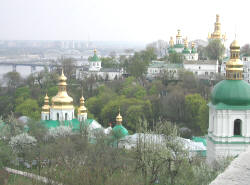 A Ukrainian Orthodox monastery founded in 1051 by the monks Antoniy
and Feodosiy. In the 11th century it became the centre for the expansion
and consolidation of Christianity in Kiev Rus'-Ukraine. The chroniclers
Nykon, Nestor, Sylvester, the artists Alimpiy, Hryhoriy, and the doctor,
Ahapit, at one time worked in the monastery. In 1240 it was looted and
destroyed by the Tatar-Mongol armies of Baty. The monastery was again
destroyed in 1480. In 1615 an imprimery was located at the monastery. In
the late 16th century it was designated a Lavra (monastery). The
architectural ensemble attained completion in the mid-18th century. The
majority of the structures is built in the Ukrainian Baroque style. The
ensemble is organically linked to the relief and forms a beautiful and
majestic silhouette of Kyiv from the Dnipro River side. In 1926 the
Calvin Cave Historical-Cultural Preserve was established on the premises
of the monastery. V. Kochubey, I. Iskra, P. Stolypin (1862-1911), the
notorious head of the Council of Ministers of Tsarist Russia, the
archaeologist D. Shcherbakivsky (1877-1927), and various distinguished
church figures are buried here.
A Ukrainian Orthodox monastery founded in 1051 by the monks Antoniy
and Feodosiy. In the 11th century it became the centre for the expansion
and consolidation of Christianity in Kiev Rus'-Ukraine. The chroniclers
Nykon, Nestor, Sylvester, the artists Alimpiy, Hryhoriy, and the doctor,
Ahapit, at one time worked in the monastery. In 1240 it was looted and
destroyed by the Tatar-Mongol armies of Baty. The monastery was again
destroyed in 1480. In 1615 an imprimery was located at the monastery. In
the late 16th century it was designated a Lavra (monastery). The
architectural ensemble attained completion in the mid-18th century. The
majority of the structures is built in the Ukrainian Baroque style. The
ensemble is organically linked to the relief and forms a beautiful and
majestic silhouette of Kyiv from the Dnipro River side. In 1926 the
Calvin Cave Historical-Cultural Preserve was established on the premises
of the monastery. V. Kochubey, I. Iskra, P. Stolypin (1862-1911), the
notorious head of the Council of Ministers of Tsarist Russia, the
archaeologist D. Shcherbakivsky (1877-1927), and various distinguished
church figures are buried here.
BUILDINGS OF THE CAVE MONASTERY COMPLEX
Uspensky (Dormition)
Cathedral(ruins), 1073-78. The
first stone structure of the monastery; the main monastery church.
During its lengthy history the cathedral was damaged, rebuilt, and
enlarged several times. In November 1941 the church was destroyed by
mines laid by Soviet forces retreating from the German advance.
Reconstructed in 2001 year.
Great Bell Tower, 1731-44. The highest monumental structure in Ukraine
(96 m) and the compositional centre of the monastery. Built in Classical
forms by the architect J. Schaedel, it consists of four stories. A
library was located on the first two stories; 13 bells were once located
on the third story, of which only three remain. A clock was located on
the fourth story.
Troyitska Nadbramna (Holy Trinity)
Church, 1106-08. Located above the main gate of the
monastery. After the destruction of the Dormition Cathedral in 1240 it
became the main monastery church. A unique monument of 18th century
Ukrainian architecture. Contains brilliant wall paintings, rich in local
scenery, historical-ethnographic material, and folk traditions. The
church floor is covered with molded cast-iron tiles.
Mykolayivska (St. Nichola's) Church, late
17th century. Built in the Ukrainian Baroque style. In the
second half of the 19th century a second floor was added. The church was
part of St. Michael's Hospital Monastery, founded in the 12th century by
Svyatoslav Davydovych, called Svyatosha, the former prince of Chernihiv,
(monk's name: Mykola) to house ailing monks. Later it was a hospice for
aged Kozaks.
Vsikhsvyatska (All-Saints') Church,
1696-98. Located above the Economic Gate in the Ukrainian
Baroque style. At the beginning of the 20th century the interior was
decorated with pictorial and ornamental oil paintings. Fragments of 17th
century paintings have been uncovered. Contains a carved and gilded wood
iconostasis from the 18th century. One of the finest monuments of
Ukrainian Baroque architecture.
Rizvda Bohorodytsi (Nativity of the Holy
Mother of God) Church, 1700. Erected on the site of a wood
church. In 1769 a carved and gilded iconostasis was installed (artist:
K. Shverin). A refectory was added in 1839. The interior was painted in
the 18th century and in 1816. Paintings by the artist D. Davydov were
completed in 1894. The main southern entrance was lavishly decorated
with molded garlands in the spirit of 17th century decorative folk art.
Bell Tower of the Far Caves, 1754-61. Erected by the master builder S.
Kovnir. A brick structure in the Ukrainian Baroque style. Forty-one m
high. Lavishly decorated with molded floral ornaments.
Annozachatiyivska (Conception of St.
Anne) Church, 1679. Located above the upper entrance to the
Far Caves. In 1796 the roof was covered with iron and the cupola was
gilded. The church was rebuilt in 1810-1819 and the pear-shaped cupola
was replaced by a new, tent-shaped cupola. In the 19th century the
interior was decorated with pictorial and ornamental paintings. The oak
iconostasis is carved.
Refectory Palace with SS. Antoniy and
Feodosiy (SS. Anthony's and Theodosius') Church, 1893-95.
Designed by Academician V. Nikolayev in the old Byzantine style. A
two-storied structure adjoined by a church with a large, spherical
cupola and five gilded cupolas. At the beginning of the 20th century the
refectory and church interiors were painted by the artists I.
Yizhakevych and H. Popov, following I. Shchusev's designs.
Near Caves, 1051. So-called
because of their proximity to the Dormition Cathedral. First mentioned
in the Tale of Bygone Years for the year 1051. Also called Anthony's
Caves in honor of the monastery's founder. The caves measure 228 m in
length, with a depth of 5-20 m. In the 1760's the floor was covered with
cast-iron tiles. The caves were first used to house monks and later as
burial places. The unique geological structure of the soil and constant
temperature resulted in the natural mummification of some of the
interred remains. There are 75 burial niches in the caves, including the
remains of Antoniy, the artists Alimpiy and Hryhoriy, and the doctors
Ahapit and Damian, Nestor the Chronicler, the religious and political
leader Nykon, Bishop Simeon, and others. In the Near Caves three crypt
churches have been preserved: Vvedenska (Presentation at the Temple)
Church, Antoniyivska (St. Anthony's) Church (11th cent.), and Varlaamska
(St. Varlaam's) Church (1641). All of them have gilded bronze
iconostasis which were executed by the Kyiv master builders F. Korobka
and Z. Yu. Bryzhunovy (1813-19).
Far Caves, 1051. First
mentioned in the Tale of Bygone Years for the year 1051. Also known as
the caves of Theodosius, in honour of the saint. They measure 280 m in
length and are 5-20 m deep. In 1826 the floor was covered with cast-iron
tiles. They contain 45 burial niches and three churches: Rizda
(Nativity), Feodosiyivska (St. Theodosius'), both of which have 18th
century bronze iconostasis, and the Blahovishchenska (Annunciation)
Church, which has a wood iconostasis, built in this century.
Besides these monuments, the Calvin Cave Monastery contains many
examples of civil architecture of the 18th-20th centuries and
fortification structures from 1698 - 1701.
3. The Golden Gate.
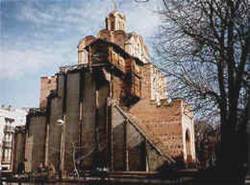 The
Golden Gate was one of the
main structures built by Yaroslav in 1037. Cut into the rampart, it
measured 6.4 meters, which was wide enough for a triumphal entry. The
"golden" part of its name emphasized the triumphal character of the gate
and also referred to the golden cupola of the Church of the Annunciation
which was built over it. The gate, destroyed during Batyi Khan's
invasion was not reconstructed, but travelers who visited Kyiv in the
16th-17th centuries left descriptions and sketches of the ruins with the
remains of the church. A century later what remained of the gate was
leveled to the ground, and it was only in 1832 that archaeologists
unearthed it, and it became a sensation. The gate was put in order,
reinforced and opened to view. Its picturesque ruins could be seen up
until recently. For the preparations for the celebration of Kyiv's
1500th anniversary a group of specialists reconstructed it in its
original for-the way it looked nearly a millennium ago. In 1983 the
Golden Gate became a museum.
The
Golden Gate was one of the
main structures built by Yaroslav in 1037. Cut into the rampart, it
measured 6.4 meters, which was wide enough for a triumphal entry. The
"golden" part of its name emphasized the triumphal character of the gate
and also referred to the golden cupola of the Church of the Annunciation
which was built over it. The gate, destroyed during Batyi Khan's
invasion was not reconstructed, but travelers who visited Kyiv in the
16th-17th centuries left descriptions and sketches of the ruins with the
remains of the church. A century later what remained of the gate was
leveled to the ground, and it was only in 1832 that archaeologists
unearthed it, and it became a sensation. The gate was put in order,
reinforced and opened to view. Its picturesque ruins could be seen up
until recently. For the preparations for the celebration of Kyiv's
1500th anniversary a group of specialists reconstructed it in its
original for-the way it looked nearly a millennium ago. In 1983 the
Golden Gate became a museum.
4. Andriyivskiy uzviz (Andriyivsky Descent)
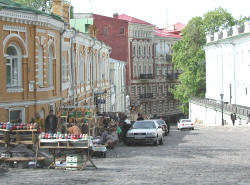 From ancient times Andriyivsky Uzviz formed the shortest route between
the aristocratic Upper Town and the tradesmen's town, Podil. It began
from the already familiar Desyatinnaya and St. Andrew's churches and ran
down a steep slope to Kontraktova square. The Uzviz (meaning descent)
acquired its present appearance in the late 19th century, and it has not
changed much since. It consists of mainly of two and three storied stone
buildings. Since the latest restoration the street has become part of
the Ancient Kyiv preservation area. It is also popular with both locals
and visitors because of its literary associations. Mikhail Bulhakov
(1891-1940), the famous writer and author of the well-known Master and
Marguerite, lived there, and the action of his other masterpieces, the
novel The White Guard and the play Days of the Turbans, was set in the
Andriyivsky Uzviz area.
From ancient times Andriyivsky Uzviz formed the shortest route between
the aristocratic Upper Town and the tradesmen's town, Podil. It began
from the already familiar Desyatinnaya and St. Andrew's churches and ran
down a steep slope to Kontraktova square. The Uzviz (meaning descent)
acquired its present appearance in the late 19th century, and it has not
changed much since. It consists of mainly of two and three storied stone
buildings. Since the latest restoration the street has become part of
the Ancient Kyiv preservation area. It is also popular with both locals
and visitors because of its literary associations. Mikhail Bulhakov
(1891-1940), the famous writer and author of the well-known Master and
Marguerite, lived there, and the action of his other masterpieces, the
novel The White Guard and the play Days of the Turbans, was set in the
Andriyivsky Uzviz area.
The street is often referred to as Kyiv's Montmartre as many artists
rent apartments and studios there. Early on summer mornings numerous
artists hang their pictures on the walls of the houses and arrange their
sculptures on the green turf of the lawns. The street is usually crowded
especially on the weekend, with people buying souvenirs, others posing
for artists, and yet others watching an improvised performances given by
actors, musicians or poets.
Starting on the top with the magnificent St. Andrew's Church, stop in at
all the shops as you walk down you will see the medieval castle, called
Richard Coeur de Lion's Castle after the hero of a novel by Sir Walter
Scott. Visit the pottery shop one of many such shops where handicrafts
are sold. Number 13 is the Literary and Memorial Museum of Mikhail
Bulhakov. The writer was fond of this street, and described many of its
houses in his books. There are several small theatres and coffee shops
as well as more museums along the way. Andriyivsky Uzviz ends near the
Kontraktova Ploscha (Square), which is the oldest square in Kyiv, going
back to the Kievan Rus period.
5. The Monastery Of St. Michael Of The Golden Domes
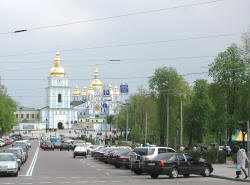 Built in
1108-1113, renovated and enlarged in the seventeenth to eighteenth
centuries, demolished 1935-36. The Monastery of St. Michael was located
to the Northeast of the Cathedral of St. Sophia, near the edge of a
bluff overlooking the Lowertown. The Monastery's main church, St.
Michael of the Golden Domes,
was built in 1108-1113 by Prince Svyatoslav II. It was the second
largest church of the medieval city and one of the three churches of the
St. Demetrius Monastery, later to be known as the St.Michael of the
Golden Domes Monastery. One of the many Byzantine churches of the Middle
Ages which were rebuilt in the Baroque style during the seventeenth to
eighteenth centuries, the Church of St. Michael was probably the most
successful in blending the original Byzantine structure with the ornate
Baroque of the eighteenth century. The interior walls of St. Michael
were still almost entirely Byzantine, while the exterior was clothed in
Baroque, conveying a picturesque appearance of rich forms and ornate
decor. As in other Baroque monastic complexes, the main entrance, at the
western end of the monastic walled in courtyard, was accented by a
tall campanile (1716-19). Nearby the church was the refectory of St.
John the Divine (1713) and the Ekonomichni Gate (1760). Inside the
church, a five tier iconostasis, funded by Hetman Skoropadskyi and
executed by Master Hryhoryi of Chernihiv, was installed in 1718. Most of
the original Byzantine mosaics and frescoes on the interior walls of St.
Michael's were painted over sometime during the eighteenth and
nineteenth centuries. Restoration and cleaning of those mosaics and
frescoes in the apse that remained unpainted commenced only at the end
of the nineteenth century. However, during this process, there was no
serious investigation of the walls of St. Michael's interior and thus
there is no way of knowing whether any medieval frescoes or mosaics were
preserved under the coats of plaster. The projected demolition of St.
Michael's Monastery generated opposition from the Ukrainian academic
community and its few Russian supporters. Soviet publications of this
period questioned known historical facts regarding the age of St.
Michael's Church. They stressed that the medieval structure had
undergone numerous alterations and that little was preserved of the
original building. In the minds of the Soviet authorities of the
mid-1930s, preservation of Ukrainian Baroque architecture was not even
worthy of consideration. Prior to its demolition (from June 8 to July
9,1934) the medieval core of the Church of St. Michael-especially the
narthex and its tombs- was studied by T. M. Movchanivskyi and K.
Honcharev of the recently purged and re-organised Institute of Material
Culture (until 1933, the Institute of Archaeology) of the Ukrainian
Academy of Sciences. Apparently on the basis of this survey,
the Institute, under the signature of its director F. Kozubovskyi and
archaeologist T. M. Movchanivskyi, established that the Church of St.
Michael was built primarily in the Baroque period rather than in the
twelfth century and thus did not merit preservation due to a lack of
historical value. This forced statement legitimized the Soviet
authorities plans regarding the entire architectural complex of St.
Michael's Monastery. In line with Soviet Ukraine's 1926
legislation. Commissar of Education V. P. Zatonskyi then authorized the
dismantlement of the historic landmark.
Built in
1108-1113, renovated and enlarged in the seventeenth to eighteenth
centuries, demolished 1935-36. The Monastery of St. Michael was located
to the Northeast of the Cathedral of St. Sophia, near the edge of a
bluff overlooking the Lowertown. The Monastery's main church, St.
Michael of the Golden Domes,
was built in 1108-1113 by Prince Svyatoslav II. It was the second
largest church of the medieval city and one of the three churches of the
St. Demetrius Monastery, later to be known as the St.Michael of the
Golden Domes Monastery. One of the many Byzantine churches of the Middle
Ages which were rebuilt in the Baroque style during the seventeenth to
eighteenth centuries, the Church of St. Michael was probably the most
successful in blending the original Byzantine structure with the ornate
Baroque of the eighteenth century. The interior walls of St. Michael
were still almost entirely Byzantine, while the exterior was clothed in
Baroque, conveying a picturesque appearance of rich forms and ornate
decor. As in other Baroque monastic complexes, the main entrance, at the
western end of the monastic walled in courtyard, was accented by a
tall campanile (1716-19). Nearby the church was the refectory of St.
John the Divine (1713) and the Ekonomichni Gate (1760). Inside the
church, a five tier iconostasis, funded by Hetman Skoropadskyi and
executed by Master Hryhoryi of Chernihiv, was installed in 1718. Most of
the original Byzantine mosaics and frescoes on the interior walls of St.
Michael's were painted over sometime during the eighteenth and
nineteenth centuries. Restoration and cleaning of those mosaics and
frescoes in the apse that remained unpainted commenced only at the end
of the nineteenth century. However, during this process, there was no
serious investigation of the walls of St. Michael's interior and thus
there is no way of knowing whether any medieval frescoes or mosaics were
preserved under the coats of plaster. The projected demolition of St.
Michael's Monastery generated opposition from the Ukrainian academic
community and its few Russian supporters. Soviet publications of this
period questioned known historical facts regarding the age of St.
Michael's Church. They stressed that the medieval structure had
undergone numerous alterations and that little was preserved of the
original building. In the minds of the Soviet authorities of the
mid-1930s, preservation of Ukrainian Baroque architecture was not even
worthy of consideration. Prior to its demolition (from June 8 to July
9,1934) the medieval core of the Church of St. Michael-especially the
narthex and its tombs- was studied by T. M. Movchanivskyi and K.
Honcharev of the recently purged and re-organised Institute of Material
Culture (until 1933, the Institute of Archaeology) of the Ukrainian
Academy of Sciences. Apparently on the basis of this survey,
the Institute, under the signature of its director F. Kozubovskyi and
archaeologist T. M. Movchanivskyi, established that the Church of St.
Michael was built primarily in the Baroque period rather than in the
twelfth century and thus did not merit preservation due to a lack of
historical value. This forced statement legitimized the Soviet
authorities plans regarding the entire architectural complex of St.
Michael's Monastery. In line with Soviet Ukraine's 1926
legislation. Commissar of Education V. P. Zatonskyi then authorized the
dismantlement of the historic landmark.
On June 26,1934, work began on the removal of the twelfth century
Byzantine mosaics. This delicate operation was carried out by the Mosaic
Section of Leningrad's Academy of Fine Arts. Leningrad's experts were
forced to work in haste due to the forthcoming demolition and
were unable to complete their work. Despite the care and attention shown
during the removal of the medieval mosaics from the walls, the resulting
relocated mosaics cannot be relied upon as being absolutely authentic.
In the spring of 1935 work commenced on the removal of the Baroque
cupolas built over the masonry domes. The silver royal gates of 1812,
Hetman Mazepa's reliquary ("raka") of some 32 kilograms of silver, and
other works of art were destroyed. Master Hryhoryi's
iconostasis disappeared. During the spring or summer of 1936 (the exact
date cannot be established) the stripped structure of St. Michael's
Church was blown up with dynamite and thus totally demolished. The
Monastery's Bell Tower, Gate, and monastic walls were also pulled down.
After the demolition, the historical site was subjected to a scrupulous
search for valuables carried out by the N.K.V.D. The mosaic of St.
Demetrius and one of the two surviving Byzantine has-reliefs were taken
to the Tretyakov Gallery in Moscow. The remaining mosaics and frescoes
were installed on the second floor of the St. Sophia Cathedral (which is
not open to the general public). Dissatisfaction with the appearance of
the first of the two proposed buildings of the Capital Centre in the
spring of 1938 apparently delayed construction of the second building
originally planned to be built on the site of the demolished Church of
St. Michael of the Golden Domes. The refectory of the demolished
monastery, though without its Baroque cupola, was preserved and in
August of 1963 was designated as a monument of architecture of the
Ukrainian S.S.R. In 1973 the Kiev City Council
established "archaeological preservation zones". The territory of
St. Michael's Monastery was included in the preservation zone. In
1997-1998 years the Bell tower and main church of monastery were
reconstructed. The work is underway